Delighting in Student Projects

One of my favorite components of education is watching students create projects that are so specific, creative, and hilarious.

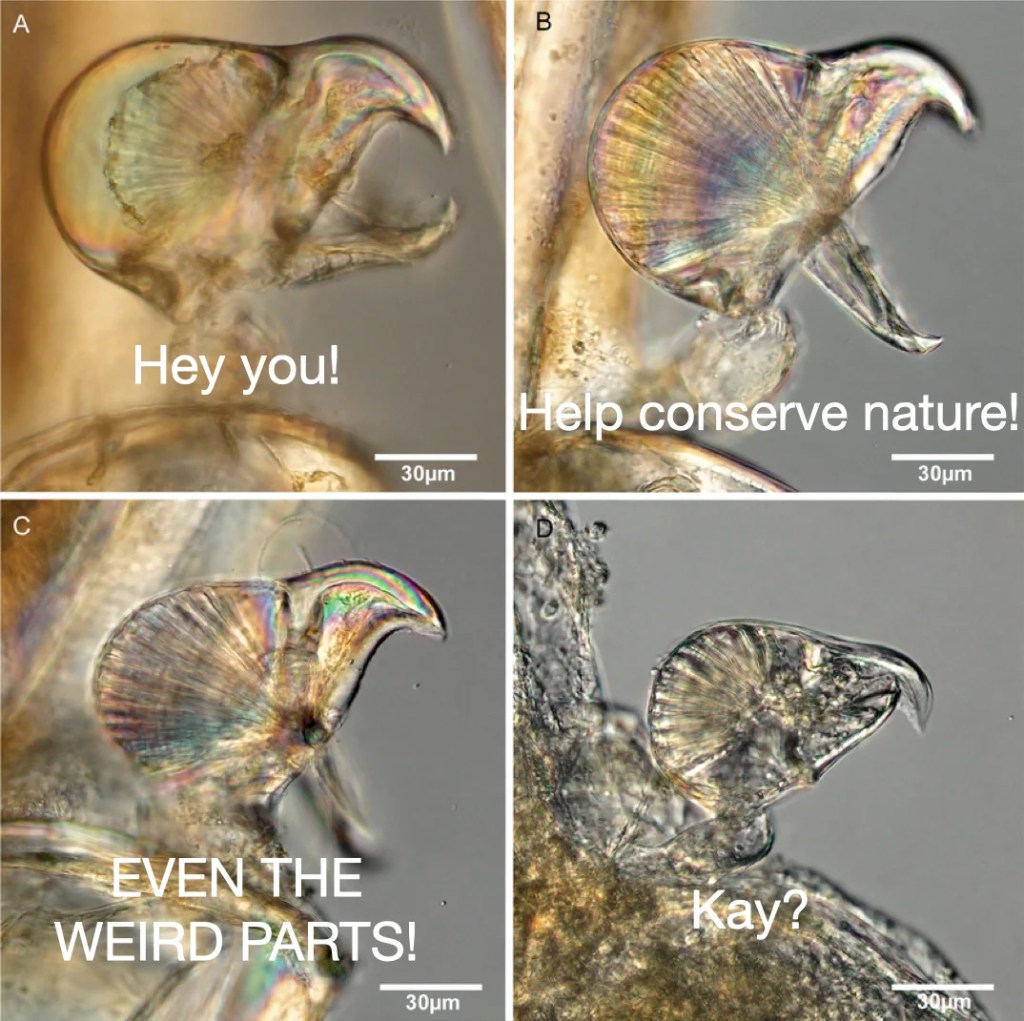
For instance–Arden, one of my students in Philosophy of Science: Conservation, made this meme recently…

…based on a figure from “Nine New Species of Bugula Oken (Bryozoa: Cheilostomata) in Brazilian Shallow Waters” (Vieira, et al. 2012)!

The target audience is very much “people who know that some bryozoans have avicularia, which look like bird beaks,” which frankly makes it even more fantastic in my eyes! Watching students combine topics from multiple classes is even better! I love it, Arden!!

Read more from Arden here:

Assessing the Accuracy of Sims 3 Marine-Themed Items

The Sims 3 is, so far, my favorite video game of all time! And, of course, given my lifelong love of marine life, I tend to select the marine-themed items for interior design!

(Despite loving the ocean as much as I do, I never bought Island Paradise. My computer already struggled to run three expansion packs at a time, and Island Paradise is a notoriously unstable expansion pack. I do have the Sims 4 Island Living pack, though, which may be the subject of a forthcoming post!)

For now, I’ll be assessing the accuracy of (selected) items from the handful of expansion packs that I have!

Crab Pot End Table (from Seasons):

Description: “Do you love boats? Do you long for the sea? Do you crave melted butter? Then, the Crab Pot end table is for you! Made from pots from genuine crab boats, you’ll have the smell of sea right in your living room.”

(It’s hard to see, but there are panes of glass on top of the crab pots)

Frankly, this is something I would purchase for my actual house. Although, smelling dead crustacean constantly might impact my capacity to smell whether any other crustaceans have died! Most conventional crab pots I’ve seen would be better suited to a coffee table, but the idea is a simply fantastic one. Starting out strong!

Nautilus Fossil (from Seasons):

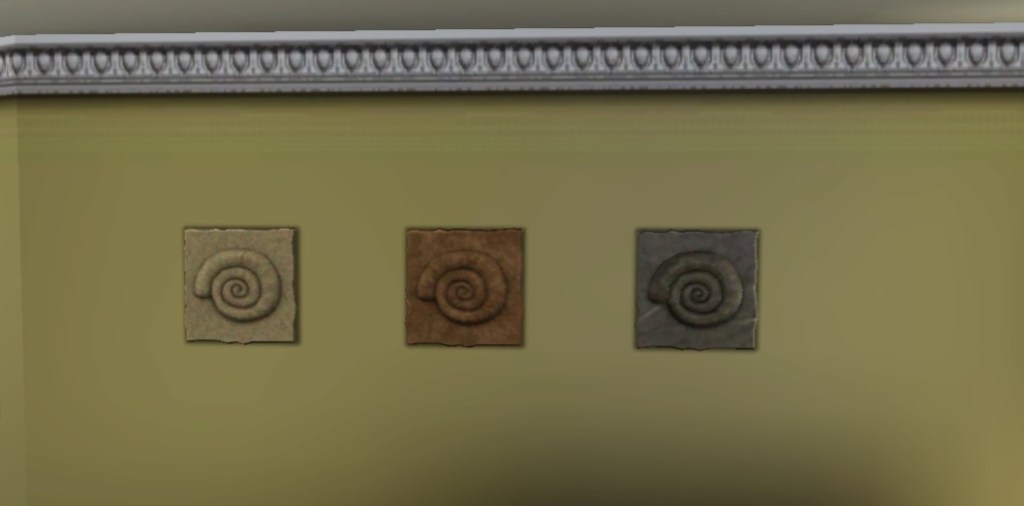
Description: “This amazing fossil captures in fine detail the glory of the genus Nautilus. Thriving in the ocean to this day, they first appeared hundreds of millions of years before modern cephalopods such as octopi and squids. Of course they were carnivores, relentless scavengers and predators of opportunity. Place one on your wall so people can say “Ooh, pretty shell!!””

Ammonite Shell Lamp (from Seasons):

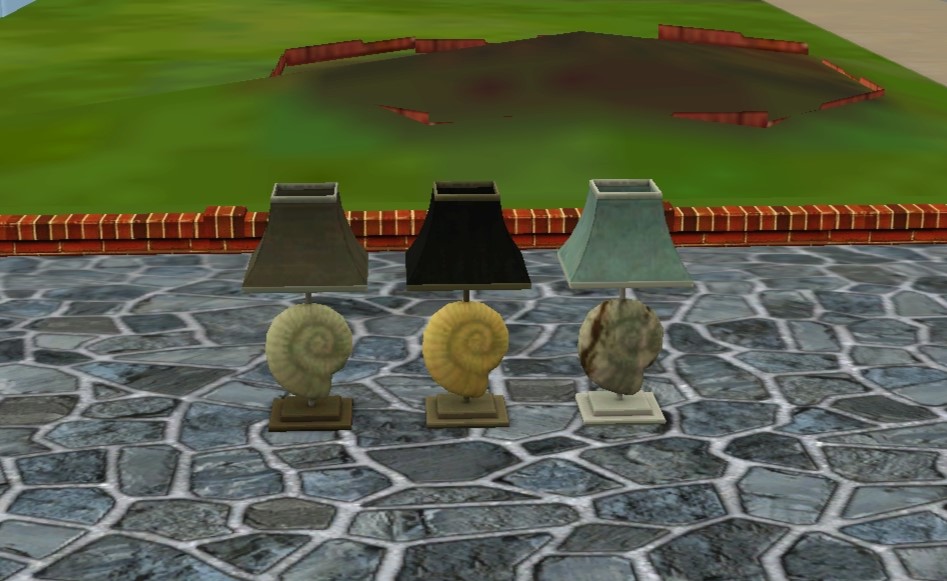
Description: “This Ammonite Shell lamp is so beautifully detailed, you’ll swear you could put your ear up to it and hear the ocean! Warning: placing your ear against a lamp can cause severe facial burns and/or electrocution. Do not place your ear against the Ammonite Shell lamp.”

These very similar cephalopod-themed items give me some pause. It can be extremely difficult to tell whether a fossil is an ammonite or a nautilus–especially from a dubiously-rendered video game object!

I am most convinced of the identity of the ammonite shell lamp–ammonite fossils tend to have ridges on their external surface, whereas nautilus fossils tend to be smooth(er) externally. But the “Nautilus Fossil”? I’m not so sure!

The structure of a nautilus shell usually shows a much wider shell structure near the opening compared to the shell making up the spiral. However, if this is the external structure of the cephalopod, then it does look comparatively smooth, which is a point for a nautiloid identity.

It doesn’t look like we’re seeing the internal structure here–if we were, we would be able to look at the position of the siphuncle! The siphuncle connects the internal shell chambers to each other so that the gas within the chambers can be controlled and therefore control the animal’s buoyancy. In nautiloids, the siphuncle runs through the center of the chambers, but in ammonoids the siphuncle tends to run closer to the external surface.

The item description for the “Nautilus Fossil” refers to octopuses as “octopi”–a more common plural when the game was released! In slightly more modern times, people are increasingly aware that octopuses or octopodes is a more accurate plural–the word “octopus” comes from Ancient Greek, whereas “octopi” would be a plural for a Latin word.

Regardless, it’s always nice to see some ancient cephalopods represented!

Olivia Octopi (Generations):

Description: “Eight-armed wonder of wide salty seas, Pirate Queen Olivia Octopi roams with her
crew fighting injustice beneath the waves and keeping perhaps a bit of the plunder for herself and her pals. Though never violent, Olivia is a fearsome foe who can unleash an ink cloud at a moment’s notice, confusing her enemies and abetting her getaway. Always at her side are her loyal crew members Cassie the seahorse and Elmo the striped fish.”

We’ve just covered the octopi vs. octopuses situation, but I suppose Olivia could potentially have the last name Octopi!

“Eight-armed” is an apt description, and I am glad to see that the Sims team utilized the correct word for her appendages! (Tentacles only have suckers on their tips, whereas arms have suckers across the entire structure. Octopuses only have arms!)

Octopus mouths don’t really smile, their mouths are in the middle of their arms, and their eyes aren’t on their mantles, but I’ve certainly seen less accurate octopus depictions in artwork for children!

Speaking of octopus depictions for children…

Monstrously Cute OctoCat (Generations):

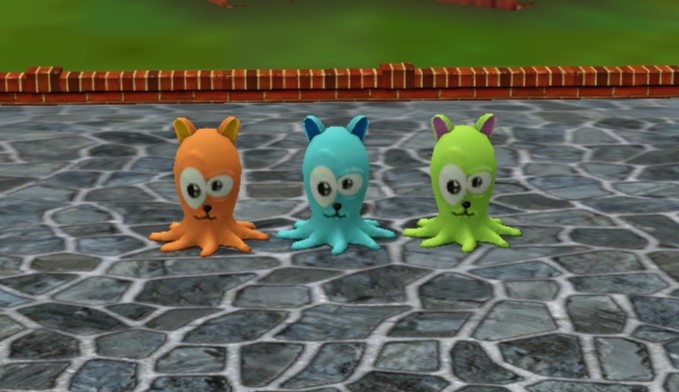
Description: “Mad scientists bent on world destruction have long created deadly animal hybrids to terrorize the unwitting populace. Who could forget the cruel attacks of the fearsome Gorlion, the terrifying Rhinoger, and the massive Elephadillo? As these attacks were inevitably thwarted by a crack special ops team, evil gene researcher Dr. Monroe turned to a different tactic: destroy the world with cuteness. Thus, the OctoCat was born!”

Personally, I think this stuffed animal is based on a flapjack octopus! (Opisthoteuthis sp.) Flapjack octopuses have fins on their mantles, and their arms have connective tissue between them like we see here.

I can confirm that OctoCats have 8 arms!

Octavian (Ambitions game registration bonus item):

Description: “Eight legs are better than two, especially when they are used for jumping! Octavian enjoys salted fish, long jaunts on the seashore, and frightening young Sims.”

I am a big fan of Octavian’s suckers on their arms–they just look cool! Each arm could use more suckers, but there isn’t a whole lot of space, so we’ll let it slide. Although their arms are referred to as “legs” in the description, it’s more accurate than “tentacles” would have been…!

Octavian’s eyes are in a slightly better location than Olivia’s, as is their mouth, so it’s an improvement!

Tentacled Wind Up (Ambitions craftable item):

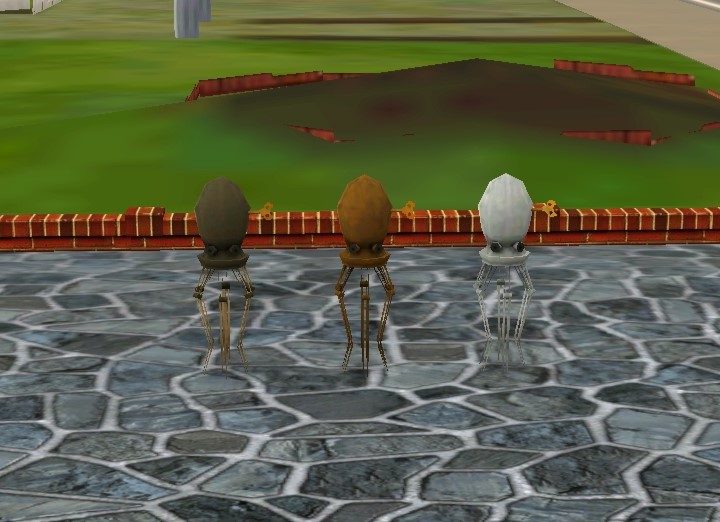
Description: “This squid-like widget is amazingly life-like and aquatically inspired.”

Well, it does say “squid-like,” so we can’t judge it too harshly! But, frankly, there’s not much judging going on. The eyes are in a fairly good place, the mantle looks broadly mantle-like, and there are 8 arms (or at least arm-like appendages)! (A squid has 8 arms and 2 tentacles–the tentacles tend to be retractable)

Whale Toy (Ambitions craftable item):

Description: “This Whale is an excellent hand-crafted toy for children!”

Despite being adorable, this item showcases a common issue with whale depictions: the water jets from their blowholes!

Whale blows are less “jets of water” and much more “clouds of mist.” Lungs need moist air to more efficiently perform gas exchange, so the air in our lungs has quite a bit of water vapor. If we breathe out on a chilly morning, we can see evidence of this–the water vapor in our breath is condensing before our eyes!

When whales breathe out, their breaths are quite forceful, pushing that warm, moist air up! Water that was sitting on top of the blowholes may also be pushed away. But a whale blow is nothing close to the jet of water we see here!

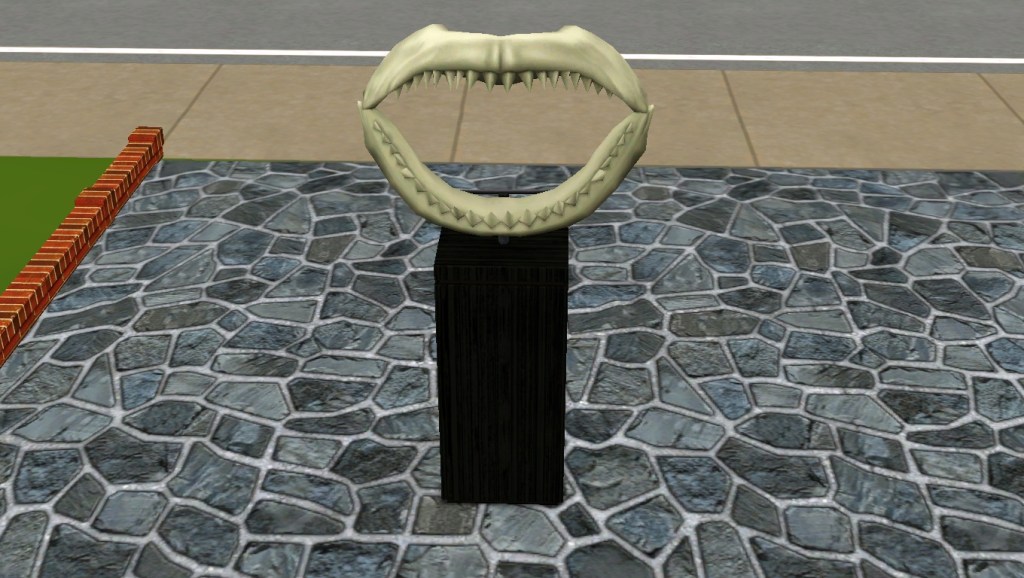
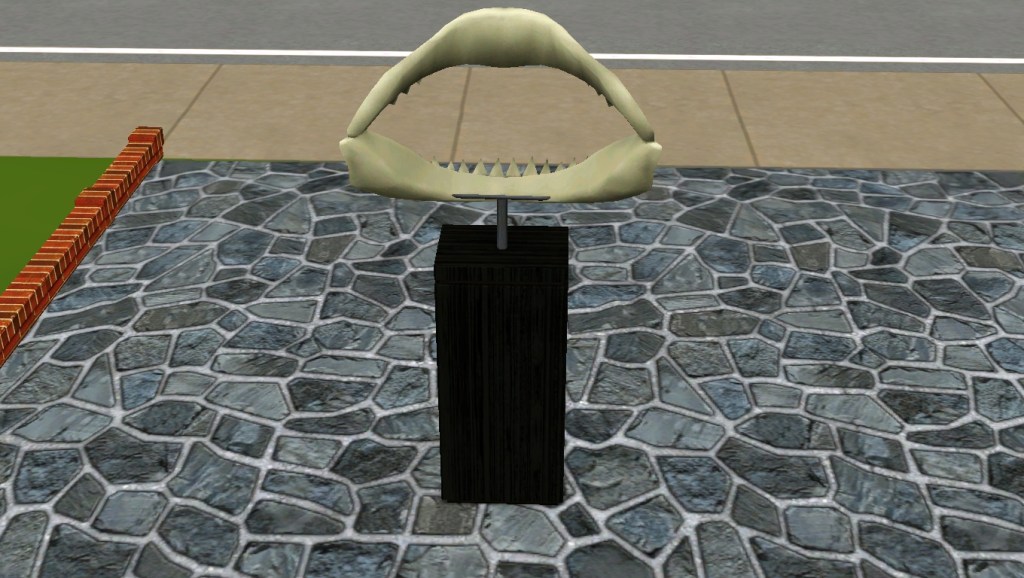
Tower of Teeth (Seasons):

Description: “This pretentiously stylish display pedestal reaffirms your spot at the top of the food chain. The shoulder high base ensures maximum visibility of the full size ceramic shark jaw replica. It’s every bit as authentic as your shark’s hunting tales.”

I recognize this is meant to be a replica…but where are all the extra teeth?!

Sharks have serially replaced teeth–their teeth aren’t fused to their jaws like ours are, so when a tooth falls out, a new one moves forward to take its place! That means that shark jaws will have many rows of teeth lined up behind their active row. You can see these rows of teeth on an actual shark jaw (of a dead shark). This is why shark teeth are fairly common finds–each shark has a lot of teeth!

Overall, a solid effort towards accuracy by the Sims team! I’m going to go look at real-life crab pot tables now…
Guest blog: Gifted People Teaching Gifted Young People

As we approach the new year, I’ve enjoyed reflecting on everything that’s happened this past year, particularly the connections I’ve built with my students.

Connecting with gifted young people is such a special part of what I do. It’s such a special part that I recently wrote an Athena’s Advanced Academy blog post about that connection!

Check it out here:

https://athenasacademy.com/gifted-people-teaching-gifted-young-people/

Are these the deepest fish?

The Internet has been buzzing with reports of “the deepest fish ever recorded” this morning! And they look quite sweet to boot:

But are these snailfish really “the deepest fish ever recorded”?! Turns out, that’s quite a complicated question!

CNN writes: “Cruising at a depth of 8,336 meters (over 27,000 feet) just above the seabed, a young snailfish has become the deepest fish ever filmed by scientists during a probe into the abyss of the northern Pacific Ocean.”

As far as I have found, yes, this is the deepest fish ever filmed.

They also write: “Along with the filming the deepest snailfish, the scientists physically caught two other specimens at 8,022 meters and set another record for the deepest catch.”

This statement is wrought with controversy!

In the paper Fishes of the hadal zone including new species, in situ observations and depth records of Liparidae (2016), Linley et al. detail fishes that have been found deep in the ocean.

Abyssobrotula galatheae is generally considered to be the deepest-living fish at a depth of 8,370 meters, which is noteworthy as it was found below the fish sighted on video! However, this is a controversial finding. The specimen was likely collected with an open net, which means there is room for error and the fish could have been caught anywhere above the maximum trawl depth. So, it’s not something we can trust.

CNN: “Previously, the deepest snailfish ever spotted was at 7,703 meters in 2008, while scientists had never been able to collect fish from anywhere below 8,000 meters.”

In the same paper linked above, Linley et al. detail two snailfish species which maximally (as far as we know) live at 8,076 meters deep and 8,145 meters deep! So, the deepest snailfish was described in 2016.

However, the deepest fish Linley et al. actually trapped was found at 7,966 meters deep. So, excluding the Abyssobrotula galatheae specimen, the newly trapped fish(es?) can still be considered the deepest captured specimens.

This discovery is exciting, as the maximum depth for fishes was previously hypothesized to be around 8,200 meters deep (in Yancey et al. 2014)! The sighting of this little snailfish allows us to reevaluate that hypothesis!

I can’t wait to see what we discover next!

How does parental care relate to juveniles’ capabilities? (in biology!)

When most people think about parental care, they think about human parents! Human parents (and parental figures) tend to care for their children a lot–and for a long time!

That high level of parental care is an adaptation! Humans have adapted to provide a level of parental care that is uncommon among other animals.

For instance, many marine invertebrates and fishes have practically no parental care! Larvae are released out into the ocean–or initially grow in the ocean–and they are on their own!

Young lobster attempting to surf on a jelly (Pelagia flaveola) at the Monterey Bay Aquarium

These youngsters have to be able to survive a lot on their own! The capability to be out on their own so early in their lives is also an adaptation. Think about it–a newborn human is not going to be able to survive on their own without anyone taking care of them! We need people to help us through our childhoods until we become self-sufficient!

In that way, the adapted capabilities of young organisms are very closely linked to the parental care parents are adapted to provide. The level of parental care given has to match youngsters’ capability to survive!

If parental care did not match how prepared youngsters were, you would end up with one of two scenarios:

  • Parents who are providing too much parental care–that stifles the juveniles! They’re ready to go out into the world, but their parents are holding them back!
  • Parents who are providing too little parental care–that leads to unprepared juveniles! They are not ready to go out into the world!

Both of these options are not ideal–so, a species’ adaptations will eventually reach a balance where parental care matches juveniles’ preparation for the real world!

What are your thoughts on parental care? Do you have any questions? Let me know!

What do Cancer pagurus crabs eat?

My Master’s research in Wales has concluded & I have officially finished my dissertation work!

I was honored to be invited to give a Science Colloquium talk through my community college in Modesto all about my Master’s dissertation work. To answer the question “what do Cancer pagurus crabs eat (among a selection of three bivalve species)?”, click below to watch my recent presentation!

Thank you to the entire Science Colloquium committee for hosting me–it was so much fun!

An Open Letter to the Monterey Bay Aquarium Tentacles Exhibit

Dear (The Monterey Bay Aquarium) Tentacles (Exhibit),

I know you will be leaving us in just…really, a couple days, at this point. On September 5th, 2022, you will end your eight-year run. And I will narrowly miss my window of opportunity to say goodbye! I’m in Wales for several more weeks, so I won’t have the option to say goodbye in person, so this is the best I can do.

Tentacles had a knack for giving me my first real-life look at animals that ranked at the top of my favorites list…and welcoming me back year after year to revisit the little critters that stole my heart.

I remember the first time, way back in 2014, that I made my way to the aquarium to see Tentacles–at the time, the experience was complete with the cephalopod arms reaching out of the roof! At first, I thought the nautiluses were fake–it blew my young mind that these animals I’d heard so much about could actually be there, right in front of me.

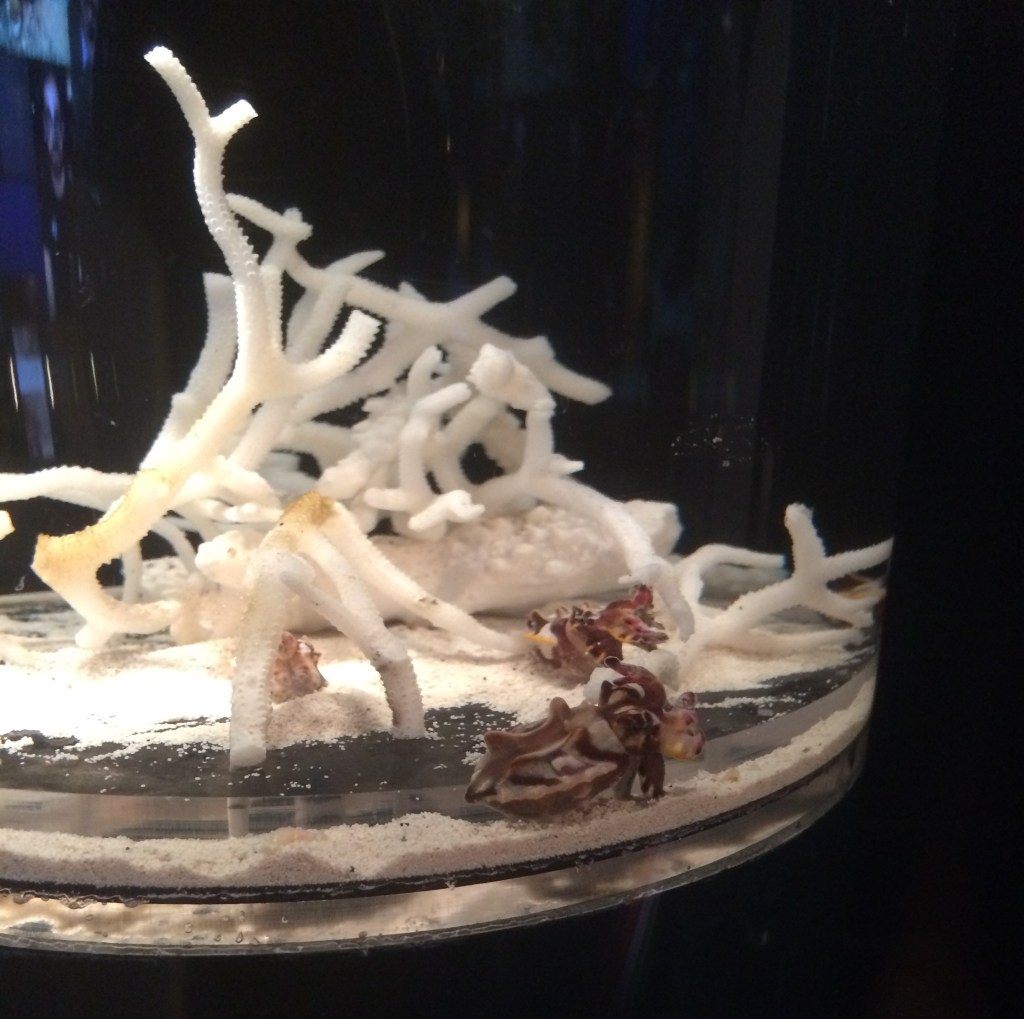
And we hadn’t even gotten to the flamboyant cuttlefish yet!

I remember the very moment I saw them in their tank, in real life for the first time since practically memorizing the NOVA documentary “Kings of Cuttlefish,” which introduced me to their fascinating, tiny selves. My mother remembers seeing the flamboyant cuttlefish too…for a very long time, as she sat on the bench next to them waiting for me to be satisfied with my level of cuttlefish observation.

I would return to that bench years later, as a student at UCSC, to study for my physics final. I cannot properly communicate how many times I heard the pun “oh, cuttlefish! Do they like to cuddle?” as I sat there.

(SCC being the Science Community Center at my community college–a fantastic place to work!)

This isn’t even to mention all the adorable young generations of flamboyant cuttlefish I’ve witnessed…

I am eternally grateful that the gorgeous music of Tentacles is available on the Internet–as well as grateful to its incredibly talented creator, Douglas Morton. The amount of time I’ve spent listening to that music while staring at various cephalopods cannot be calculated, so it goes without saying that I have a deep attachment to the music itself. It never fails to bring a smile to my face and remind me of the precious cephalopods I’ve seen soundtracked to that music.

Reef squid!

I was sick for my birthday in 2017. We were going to go to the aquarium with my grandparents for my birthday, but that was definitely a bad idea because I was pretty substantially sick, so we waited it out a week. This turned out to be an excellent decision.

There had been whispers of a flapjack octopus at the aquarium that week and I hoped beyond hope that it would stick around until I was able to see it.

As per usual, the instant we got to the aquarium, I led the pack directly to Tentacles. I forged ahead, leaving everyone behind, just wanting to see if my favorite adorable cephalopod was there.

And it was!! There was a creature I’d only seen in videos, bathed in red light to keep it calm, having the time of its little life rising to the surface and sinking back down.

That little octopus would go on to grace my phone’s lock screen for over four years!

Thank you, Tentacles, for all the cephalopods you’ve shown me and all the memories you’ve left with me over the last eight years. I will miss you–you and your steampunk art, old movie clips, beautiful soundtrack…and most of all, your cephalopods.

~ Emma

Looking at Marine Biology through a Historical Lens

The history of the field of marine biology has fascinated me for my whole life. I chose to write an essay about Jacques Cousteau (marine filmmaker and inventor of the AquaLung) when I was eight. I read The Sea Around Us by Rachel Carson (who saved the biosphere from DDT) multiple times when I was eleven. I devoured Between Pacific Tides by Ed Ricketts (marine ecology pioneer) when I was sixteen. One of my favorite websites to peruse is the Marine Ecology Family Tree!

It’s really no surprise that I created a course entitled Marine Biology Through History!

But, my interest extends beyond my pure fascination with the field’s history. I believe studying the history of marine biology (and ecology) gives us a valuable perspective, particularly for relative newcomers like myself and my students.

Learning about the history of our field contextualizes biological and ecological details. Exploring the rich histories of marine institutions, scientists, and vessels allows us to understand how the field has evolved throughout the centuries. Plus, we can learn when the field discovered something for the first time–which may have been earlier than we’d expect. I have been repeatedly surprised by how much accurate information I’ve read in publications from the 1900s and 1800s!

History can also teach us humility. Amongst the accurate information lives a treasure trove of past beliefs that turned out to be inaccurate. One of my favorite examples is the paper nautilus–scientists used to believe that females used their specialized arms not for building their egg cases but for sailing!

Although these misled beliefs can be extremely entertaining (particularly for students) they also remind us that, eventually, some of what we now believe to be fact will one day be proven wrong. As we continue to pursue knowledge, it is inevitable that we will discover more inaccuracies hiding in textbooks.

I’ve found that it can be beneficial to frame our collective knowledge base as ever-changing rather than fixed, especially in educational settings. During my courses, we often discover changes to scientific nomenclature or information together, cementing the fact that the field continues to evolve.

Perhaps most importantly, history can push us towards a more inclusive path. As was the case in many fields, marine biology was historically dominated by white, straight, cisgender men. That being said, many influential people in historically underrepresented groups overcame discrimination to contribute to our field. (A particularly poignant example is the life of Dr. Roger Arliner Young.) And it’s important to remember how indigenous groups were excluded from many conservation/natural history conversations and that their ecosystem functioning knowledge was often disregarded.

Marine ecologists often speak about the benefit of species diversity. What about human diversity?

Reading the stories of people who pushed through societal boundaries to further scientific knowledge motivates me to do all I can to make my field more inclusive.

I choose to highlight the accomplishments of people from historically underrepresented groups in Marine Biology Through History. I feel it is important for students to see themselves in the history of this field as we move forward. Although we have made progress, there is still plenty of work to be done.

As they continue in their careers, I want to make sure that my students know that people of all sorts of backgrounds and identities have contributed to this field in the past and still contribute to it now. Our diversity as a species is something we ought to embrace.

I think my fascination with the history of my field has become less of a hobby and more of a responsibility. After all, we all stand on the shoulders of giants. Isn’t it prudent to learn about who those giants were?

Ecology Explained: Settlement & Recruitment

Marine ecologists specializing in larvae often use two similar terms seemingly interchangeably: settlement and recruitment. What do these terms mean?

We use the word “settlement” to describe the transformation between the planktonic larval phase and the sessile/benthic adult phase. A settler is any organism that is no longer floating free in the water column–it’s now either physically attached to a habitat (like barnacles attaching to a rock) or metaphorically attached (like a fish settling around a particular coral colony).

On the other hand, we use the word “recruitment” to describe the addition of newly settled organisms into the population that scientists or surveyors have measured. So, a recruit is an organism that a scientist has seen in a settled form. Hypothetically, the number of recruits equals the number of settlers. However, this is rarely, if ever, the case. Post-settlement mortality, sampling bias, and other factors practically ensure that the measured recruitment number does not equal the actual settlement number.

I couldn’t find a good Settlement vs. Recruitment diagram on the Internet, so I made my own!

In this diagram, we start out with twenty barnacle settlers on this rock face (yes, they are orange in real life!). But time has passed before our surveyor comes along to count this year’s new barnacles. Some barnacles have died between settlement and recruitment recording. So, our surveyor only finds 13 barnacle recruits! The number of recruits does not equal the number of settlers.

Time is critical when measuring recruitment. The less time between settlement and recording, the better, as fewer new settlers have died. However, it can be very difficult to reduce the time between settlement and when we measure recruitment. Factors such as tides, weather conditions, and funding can reduce scientists’ ability to minimize this bias.

Plus, real life isn’t as simple as this diagram! It’s easy to miss a barnacle or two (or three, or twenty) hiding in a crevice or in the shadow of an adult barnacle while sampling. Or, the area measured may not be indicative of larger-scale settlement patterns!

In order to separate these two concepts, we use the terms “settlement” and “recruitment” to reduce confusion and more accurately describe what we’re talking about!

Do you have a lingering question about settlement and recruitment? Ask it in the comments section and I will be happy to help as best I can!

PSA: Bryozoans are awesome!

We just covered lophophorates in In-Depth Marine Biology, which was great fun for me (I love lophophorates!). I’ve noticed that, somehow, many people haven’t heard of these wonderful animals. So I tasked my class with creating Public Service Announcements to inform the public about these wonderful creatures.

One student, Maria C., wrote a whole song about bryozoans! Take a listen below–it’s very catchy! (the video has no visuals, just sound)

It’s been stuck in my head for a while now! Even more amazing: it’s the first song she’s written! Incredible job, Maria!